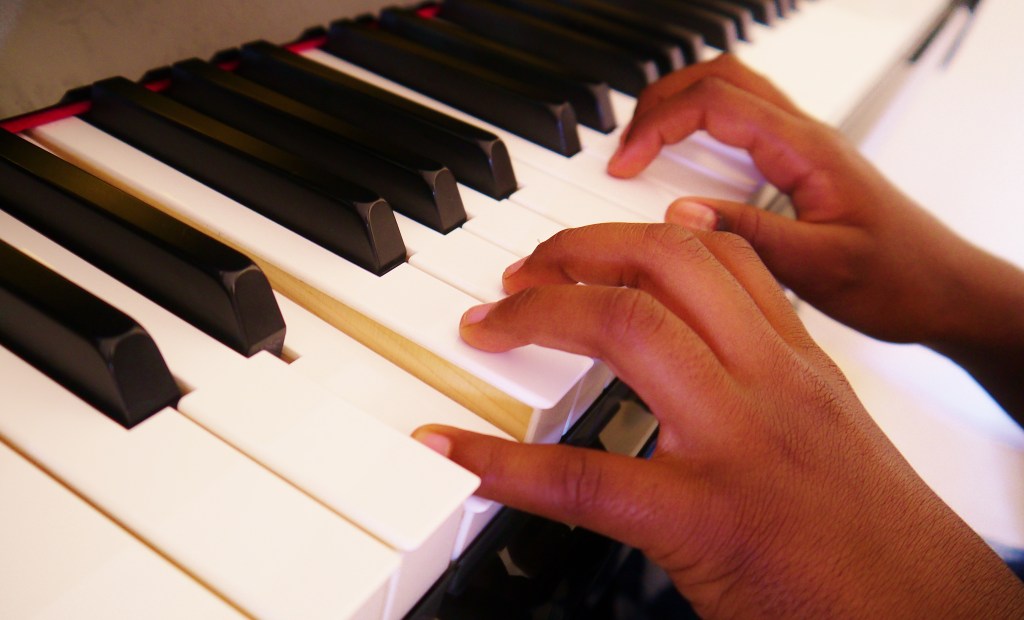
Whether you are interested in piano lessons (or keyboard lessons) for yourself or your child, in classical styles and technique or a more modern style such as jazz or pop, I have specific qualifications in Piano and Music Theory (ABRSM Grade VIII), together with qualifications in teaching children (Primary PGCE at Master’s level) and adults, along with the experience to help you reach your goals.
I provide holistic music lessons integrating not only technique and style but also aural skills, music theory and creative activities such as improvisation to a variety of adults and children in the Bournemouth and Christchurch area. Sometimes students decide to enter for music examinations: so far, every student I have entered has passed their Practical examinations, and everyone entering for an ABRSM Music Theory examination (from Grade I up to Grade V) has achieved a Distinction – this is a testament, of course, as much to their own application, dedication and achievement as it is to mine.
For children, I am able to offer piano lessons (and music theory lessons) at a relaxed pace completely outside of the school timetable, which enables ambitious students to concentrate fully on their other subjects during the school day. It can also be the case that school music lessons take place for fewer weeks throughout the year, which is often not best-suited for a committed student seeking to sustain progress.
Safeguarding considerations are paramount and I subscribe to DBS Update, which means my DBS certification is continuously up-to-date. The business is also registered with the Information Commissioner’s Office as a Data Controller.
I offer initial face-to-face consultations with prospective clients and students free-of-charge.
“Thank-you so much for your time and patience in teaching me the piano. I know I am a slow learner, but you never made me feel that, thank-you so much.”
“My daughter thoroughly enjoys her piano lessons. She has made tremendous progress since starting with Brett. Highly recommend.”
Piano Lessons FAQ
What type of keyboard instrument do I need?
You really need either an acoustic piano that you keep in tune at least once a year (twice would be ideal – once after the winter and again after the summer) or an electronic keyboard that is either weighted or otherwise touch sensitive so that you can bring out changes in loudness and softness (piano is short for pianoforte, which means soft-loud). If you have a keyboard that is not touch-sensitive and you are interested in trying out lessons for your child, they could certainly start with that keyboard but you would need to plan to buy a touch-sensitive keyboard if they take to it.
Please also have a metronome that you can use at home for your practice sessions: if you are using an electronic keyboard, this might be integrated into it already.
What about practising?
For beginners and especially younger children, little and often is a good principle, as it is with other areas of learning such as developing reading skills or knowledge of times tables facts. For older children and adults, creating a practice timetable can be very useful. It is important that music students clearly understand what they need to practice, and what they are aiming for, otherwise they might be ingraining errors in their playing.
I offer guidance on practice suggestions through the week, especially for younger children, however another principle is that we want the student increasingly to take responsibility for their own practice and enjoyment of music according to their developing maturity and ability.
At the intermediate stages and beyond (Grade III and above), if lack of practice leads to an impasse lesson by lesson in terms of progress with a piece a child is learning, I will discuss this with the client. For beginners, daily practice will often dramatically increase the speed at which they progress to reach more and more sophisticated and interesting pieces.
What about piano gradings?
I have experience teaching at beginner, intermediate and advanced levels. Please let me know whether entering for piano gradings is important to you. They can be a useful target and celebration of progress, but music education and enjoyment should always be broader than passing assessments.
How do I get in touch?
Details of half-term dates, fees and charges, terms and conditions and practical information are contained in the music lessons tuition guide, which is available on request.
For more information about how the tuition I provide can support you, please send an outline of your tuition requirements, availability and phone number to this email address: brett.milner.tuition@outlook.com.
Thank you for your interest in having piano lessons with me.
“I like that my daughter gets to improvise and that she enjoys learning the piano without undue pressure.”
”The music theory was fascinating.”
 Brett Milner Tuition